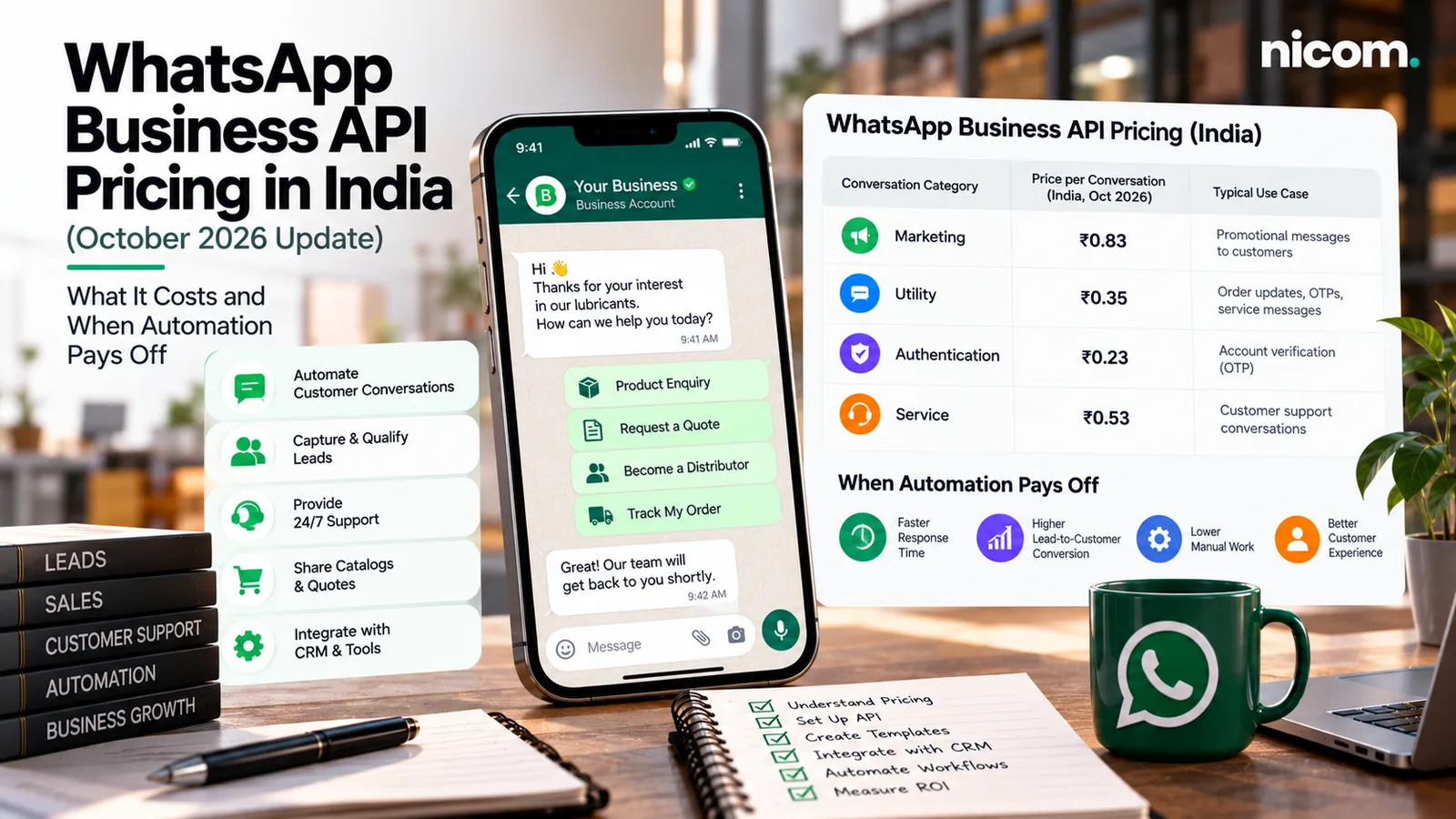
Short answer: on the WhatsApp Business Platform (the “WhatsApp API”), Meta charges per delivered message, based on the message category and the recipient’s country. For recipients in India, Meta’s published INR rates effective 1 October 2026 are ₹0.8631 per marketing message and ₹0.115 per utility, authentication or service message. Each business phone number gets 1,000 free service messages a month. Your WhatsApp solution provider’s platform fees and applicable taxes are on top of Meta’s charges.
WhatsApp Business API pricing confuses a lot of business owners, and the October 2026 update changed a few things that had been free, so if you set up WhatsApp automation earlier, your bill may look different now. This guide explains the current pricing in plain language, with worked examples, and when automation actually pays for itself.
Rates verified against Meta’s official Pricing on the WhatsApp Business Platform page and its INR rate card on 18 October 2026. Meta can update rates at the start of each quarter, so always check the current rate card before budgeting.
WhatsApp Business App vs WhatsApp Business Platform (API)
First, a common confusion. The free WhatsApp Business app on your phone doesn’t charge per message. The pricing below applies to the WhatsApp Business Platform, which you use through Meta’s Cloud API, usually via a solution provider. The Platform is what you need for automation at scale: chatbots, CRM integration, broadcast campaigns to opted-in customers, multiple agents on one number, and automatic notifications.
How Meta charges: the four main message categories
| Category | What it’s for | Example |
|---|---|---|
| Marketing | Promotional template messages | Festive offer, new product launch, re-engagement message |
| Utility | Transactional or informational template messages | Order confirmation, delivery update, appointment reminder |
| Authentication | One-time passwords for identity verification | Login OTP |
| Service | Free-form (non-template) replies to customers within the 24-hour customer service window | Answering a customer’s question about stock or pricing |
Meta’s pricing page also lists a fifth category, Meta Business Agent, for AI agent replies built on Meta’s own agent platform. It is billed differently (per token), so we’ve left it out of the examples below.
Key rules from Meta’s pricing documentation:
- You’re charged when a message is delivered, not when it’s sent.
- The rate depends on the category and the recipient’s country calling code (+91 for India).
- Meta does not charge for messages customers send to you.
- Template messages are needed to start a conversation. Free-form messages can only be sent inside an open 24-hour customer service window, which opens or resets each time the customer messages you.
Current India rates (effective 1 October 2026)
| Category (recipient in India) | Meta rate per delivered message (INR) |
|---|---|
| Marketing | ₹0.8631 |
| Utility | ₹0.115 |
| Authentication | ₹0.115 |
| Authentication – international | ₹2.4971 |
| Service (after the free monthly tier) | ₹0.115 |
Source: Meta INR list rates, effective 1 October 2026, linked from the official pricing page. These are Meta’s charges only. Solution provider fees and taxes are extra.
What changed on 1 October 2026
Service messages are charged again, after a free tier
Meta resumed charging for service messages. Every business phone number gets 1,000 free delivered service messages per month. Meta charges from the 1,001st service message. Unused free messages don’t roll over, and the count resets monthly.
Utility templates inside the service window are now charged
Utility template messages sent while a customer service window is open had been free. Meta’s documentation says these are now charged as regular utility messages.
Payment method matters
Meta notes that if a messaging account has no payment method, service messages within the free tier will still be delivered, but not after the free tier is used up. If you rely on WhatsApp for customer support, make sure billing is set up.
When messages are free
Meta’s documentation lists two situations where it does not charge:
- The free entry point window. When someone messages you from a Click-to-WhatsApp ad using the WhatsApp mobile app on Android or iOS, and you reply within the customer service window, a free entry point window opens. Meta’s documentation says it can stay open for up to 7 days, and during it marketing, utility, authentication and service messages are not charged. This makes Click-to-WhatsApp ads especially cost-effective for follow-up conversations.
- The first 1,000 service messages each month, per business phone number.
Volume tiers
Meta offers volume-based discounts only for utility and authentication messages, calculated per market and category across your business portfolio. For India, the INR rate card shows the list rate applying up to 2.5 crore (25,000,000) utility messages and 7.5 lakh (750,000) authentication messages a month, with lower rates beyond that. Most small and mid-size businesses will pay the list rate.
Worked examples (Meta charges only)
Example 1: A Delhi clinic sending appointment reminders
- 2,000 utility reminders a month × ₹0.115 = ₹230
- 1,500 service replies to patient questions: first 1,000 free, 500 × ₹0.115 = ₹57.50
- Meta total: about ₹287.50 a month, plus provider fees and taxes
Example 2: A D2C brand running a festive campaign
- 10,000 marketing messages to opted-in customers × ₹0.8631 = ₹8,631
- 5,000 order and delivery updates × ₹0.115 = ₹575
- 800 service replies: within the free tier = ₹0
- Meta total: about ₹9,206, plus provider fees and taxes
Example 3: A B2B distributor using Click-to-WhatsApp ads
Dealers who message from a Click-to-WhatsApp ad, and get a reply within the service window, open a free entry point window. Follow-up messages in that window, including price sheets sent as templates, aren’t charged by Meta. Ad spend is separate.
Other costs to budget for
- Solution provider (BSP) fees: most businesses use a provider’s dashboard for inbox, chatbot, broadcasts and integrations. Pricing models vary: monthly plans, per-message mark-ups or both. Ask for the full cost per message, including Meta’s charge.
- Taxes: check how GST is applied on your invoices.
- Set-up and automation work: building chatbot flows, templates, CRM integration and reports.
- Team time: someone still needs to handle conversations the bot can’t.
When WhatsApp automation pays off
WhatsApp automation is usually worth it when:
- You get enough enquiries that replies are delayed or missed.
- Leads come from ads or the website and need an instant first response.
- Your team sends the same information repeatedly: price lists, catalogues, location, timings.
- You send regular transactional updates (orders, appointments, payments).
- You want every conversation logged in a CRM instead of on individual phones.
It’s usually not worth it yet if you get a handful of chats a day and one person can comfortably handle them on the WhatsApp Business app.
Tips to keep your WhatsApp bill under control
- Categorise templates honestly. Meta categorises templates by their content, so promotional wording belongs in marketing templates. Don’t try to pass offers off as utility messages.
- Use the service window. Reply quickly while the customer’s window is open rather than sending templates later.
- Segment broadcasts. Sending marketing messages to everyone is the fastest way to raise costs and block rates.
- Use Click-to-WhatsApp ads where they fit, to benefit from the free entry point window.
- Track results per template. Drop messages that don’t drive replies or orders.
- Only message people who have opted in. Meta requires opt-in, and it protects your number’s quality rating.
Frequently asked questions
Is the WhatsApp Business API free in India?
No. Meta charges per delivered message by category. Messages from customers to you are free, the first 1,000 service messages per number per month are free, and messages in a free entry point window from Click-to-WhatsApp ads aren’t charged.
What is the cost of a WhatsApp marketing message in India?
Meta’s list rate for India, effective 1 October 2026, is ₹0.8631 per delivered marketing message, before provider fees and taxes.
Are service messages free on WhatsApp now?
Since 1 October 2026, each business phone number gets 1,000 free service messages a month. After that, Meta charges the India service rate of ₹0.115 per delivered message.
How often does Meta change WhatsApp pricing?
Meta’s documentation says pricing may be updated only on the first day of a quarter: 1 January, 1 April, 1 July or 1 October.
Do I need a solution provider to use the WhatsApp API?
Businesses can integrate directly with Meta’s Cloud API, but most small and mid-size businesses use a solution provider or an agency for the inbox, automation and integrations, which adds its own fees.
Thinking about WhatsApp automation?
We help businesses set up WhatsApp flows that reply instantly, qualify leads and sync conversations with their CRM, with the costs worked out in advance. See our WhatsApp automation service and how it connects with marketing automation, or ask us for a cost estimate based on your monthly message volume. You can find more practical guides on our Insights page.