
seo-organic-growth / technical-on-page-seo
Technical & On-Page SEO
Build a Website Search Engines Can Understand
Good SEO starts with a website that is technically sound, well structured and easy for both search engines and users to navigate.
NICOM helps businesses improve the technical and on-page foundations that support organic visibility.
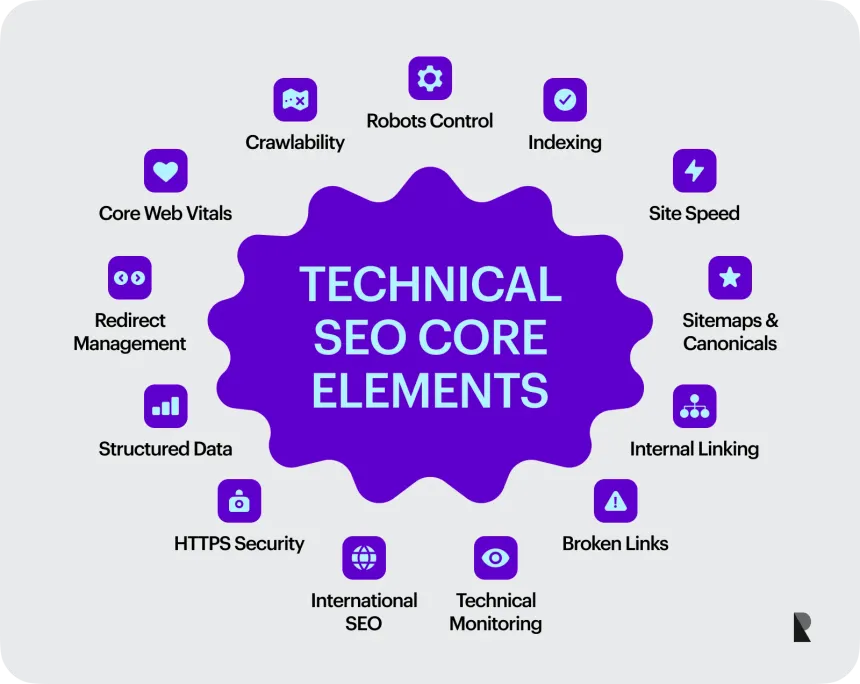
We work across areas such as website architecture, crawlability, indexing, metadata, headings, internal linking, structured data, Core Web Vitals, mobile experience and content structure.
The goal is simple:
Make your website easier to crawl.
Easier to understand.
Easier to navigate.
And better for the people using it.
What We Optimize
A Complete Technical & On-Page SEO Framework
Our work can cover:
- Website architecture
- Crawlability
- Indexing
- URL structure
- XML sitemap
- Robots.txt
- Canonicalization
- Metadata
- Headings
- Internal linking
- Image optimization
- Structured data
- Schema markup
- Core Web Vitals
- Mobile responsiveness
- Page performance
- Content structure
- Keyword-to-page alignment
- Search intent
- On-page relevance
These areas reflect the technical and on-page SEO scope in the supplied NICOM material.
Two Sides of the Same Websitex
Technical SEO and on-page SEO address different aspects of search performance, but they work together.
Technical SEO Audit
Find the Issues That May Be Limiting Your Website
Before making changes, we examine the technical foundation of the website.
An audit can identify issues related to:
- Crawlability
- Indexing
- Website architecture
- URL structure
- Sitemaps
- Robots.txt
- Canonical URLs
- Page performance
- Mobile experience
- Internal linking
- Structured data
- Duplicate content
- Broken pages
- Redirects
The purpose isn’t simply to generate a long technical report.
It is to identify which issues matter, why they matter and what should be addressed first.
Website Architecture
Create a Structure Search Engines Can Follow
A well-organized website helps users and search engines understand how information is connected.
We consider:
Homepage → Main Categories → Subcategories → Service / Product Pages → Supporting Content
This structure can help establish relationships between pages and distribute internal authority throughout the website.
A strong architecture also makes it easier to expand the website without creating unnecessary complexity.
Crawlability
Help Search Engines Discover Your Important Pages
Search engines need to crawl your website before they can properly evaluate its content.
We look for issues that could prevent or complicate crawling, including:
- Broken internal links
- Poor navigation
- Incorrect directives
- Unnecessary URL variations
- Crawl traps
- Poor site architecture
- Orphan pages
- Incorrect robots.txt configuration
The goal is to make important pages accessible while reducing unnecessary crawling of pages that do not need search visibility.
Indexing
Make Sure the Right Pages Can Appear in Search
Crawling and indexing are not the same thing.
A search engine may discover a page but still decide not to index it.
We review indexing-related factors such as:
- Indexability
- noindex directives
- Canonical URLs
- Duplicate pages
- Thin pages
- Redirects
- Sitemap coverage
- Indexing inconsistencies
The objective is to help search engines understand which pages are important and should be considered for search visibility.
XML Sitemap
Help Search Engines Understand Your Website Structure
An XML sitemap provides search engines with information about important URLs on your website.
We can review:
- Sitemap availability
- Sitemap structure
- Included URLs
- Incorrect URLs
- Redirected URLs
- Non-indexable URLs
- Sitemap submission
- Sitemap consistency
A sitemap is not a replacement for good internal linking or website architecture, but it can support the discovery and understanding of important pages.
Robots.txt
Control How Crawlers Access Your Website
The robots.txt file can provide instructions to search-engine crawlers about which areas of a website should or should not be crawled.
We can review the configuration to identify:
- Incorrect directives
- Unnecessary blocking
- Important pages being restricted
- Crawlable areas that should be controlled
- Sitemap references
Robots.txt needs to be handled carefully because an incorrect configuration can unintentionally restrict access to important website resources.
URL Structure
Keep URLs Clear and Meaningful
URLs are part of your website’s information architecture.
We look for URLs that are:
- Clear
- Descriptive
- Consistent
- Relevant to the page
- Easy for users to understand
We can also review unnecessary parameters, duplicate URL variations, redirects and structural inconsistencies.
A clean URL structure can make the website easier to manage as it grows.
Canonicalization
Tell Search Engines Which Version Matters
Websites can sometimes contain multiple URLs that lead to similar or identical content.
Canonicalization helps communicate the preferred version of a page.
We can review:
- Canonical tags
- Duplicate URLs
- Parameter variations
- HTTP / HTTPS versions
- WWW / non-WWW versions
- Similar content
- Pagination and other URL variations where applicable
The aim is to reduce ambiguity and help search engines understand the preferred version of important content.
Metadata
Help Search Engines and Users Understand the Page
Metadata provides important information about individual pages.
We can optimize:
01
Title Tags
Clear, relevant titles aligned with the page and search intent.
02
Meta Descriptions
Useful descriptions designed to communicate what the page offers.
03
Other Relevant Metadata
Where applicable, we review metadata implementation as part of the broader on-page SEO structure.
Metadata should be written for real searchers first, rather than simply filling fields with keywords.
Heading Structure
Create a Clear Content Hierarchy
Headings help organize page content for users and search engines.
We review:
- H1
- H2
- H3
- Supporting heading levels
- Heading hierarchy
- Content organization
A page should have a logical structure where the main topic is clear and supporting sections are properly organized.
On-Page SEO
Optimize the Page Around Its Purpose
On-page SEO is about more than keyword placement.
We consider the complete page:
Topic → Search → Intent Title → Headings → Content → Internal Links → Images → Structured Data → Conversion Path
The goal is to make the page useful, relevant and clearly aligned with what the searcher is looking for.
Keyword-to-Page Alignment
Match the Right Page to the Right Search
A common SEO problem is trying to make one page rank for too many unrelated topics.
We help map relevant search terms to appropriate pages.
For example:
This creates clearer relationships between search intent and website content.
The supplied NICOM SEO framework specifically includes keyword-to-page mapping as part of on-page optimization.
Search Intent Alignment
Give Searchers What They Are Actually Looking For
Search intent should influence how a page is optimized.
A search may be:
Informational
The user wants to learn something.
Commercial
The user is researching or comparing options.
Transactional
The user is ready to take an action.
Navigational
The user is looking for a particular brand, website or destination.
We assess whether the existing page actually satisfies the intent behind the searches it is targeting.
If the intent and page don’t match, simply adding more keywords won’t solve the underlying problem.
Internal Linking
Connect Your Important Pages
Internal links help users navigate the website and help search engines understand relationships between pages.
A well-planned internal linking structure can connect:
Pillar Page → Supporting Content → Service / Product Pages → Related Pages
- Important internal links
- Orphan pages
- Anchor text
- Contextual links
- Navigation links
- Related content
- Internal authority flow
Internal linking is also useful for creating stronger topic relationships across the website.
Image SEO
Make Images Work for Search and Users
Images are important for both user experience and page performance. We can review:
- Image file sizes
- Image formats
- Compression
- Descriptive filenames
- Alt text
- Image dimensions
- Responsive images
- Lazy loading where appropriate
The objective is to maintain visual quality while reducing unnecessary performance overhead.
Structured Data & Schema
Help Search Engines Understand Your Content
Structured data provides additional context about the information presented on a page.
Depending on the content, this can include structured information relating to:
- Organization
- Products
- Services
- Articles
- Breadcrumbs
- FAQs
- Other relevant entities
Schema should be implemented based on the actual content of the page rather than added simply because a markup type exists.
The supplied NICOM technical SEO framework specifically identifies structured data and schema markup as technical/on-page optimization areas.
Core Web Vitals
Technical Performance Matters
Search engines consider page experience as part of their broader evaluation, while users naturally expect websites to load and respond quickly.
We can review performance areas associated with:
- Loading experience
- Interactivity
- Visual stability
- Mobile performance
- Page resources
- Images
- Scripts
- Layout
- Technical implementation
Core Web Vitals are specifically included in the supplied NICOM technical SEO framework.
Mobile SEO
Optimize for the Devices Your Audience Uses
A website needs to work properly across screen sizes.
We consider:
- Responsive layouts
- Mobile navigation
- Text readability
- Buttons and touch targets
- Images
- Page speed
- Forms
- Content visibility
- Mobile user experience
Mobile SEO is not a separate version of SEO.
It is part of creating a website that works well for modern users.
Technical SEO + Website Development
SEO Should Be Part of the Build
Technical SEO works best when it is considered during website development rather than added after the website is already built.
NICOM can connect:
Planning → Architecture → Development → Technical SEO → On-Page Optimization → Testing → Launch
This is especially useful for new websites, redesigns and migrations.
Technical SEO for WordPress
Optimize the Foundation Without Breaking the Website
WordPress websites often depend on themes, plugins, custom functionality and third-party integrations.
Technical SEO needs to consider how these components work together.
We can review:
- WordPress structure
- Plugin impact
- Theme implementation
- URLs
- Metadata
- Sitemaps
- Indexing
- Internal links
- Performance
- Structured data
- Mobile experience
Mobile SEO is not a separate version of SEO.
It is part of creating a website that works well for modern users.
Technical SEO for Shopify
E-commerce SEO Requires a Different Technical Approach
Shopify provides a managed e-commerce environment, but there are still important areas to consider around:
- Product structure
- Collection structure
- URLs
- Metadata
- Internal linking
- Product content
- Images
- Structured data
- Performance
- Indexing
- Duplicate content
Technical SEO should work alongside the store’s commercial structure and customer journey.
Technical SEO for E-commerce
Make Large Product Catalogues Easier to Understand
E-commerce websites can become technically complex as products, variants, categories, filters and collections increase.
We can consider:
- Product and category architecture
- Faceted navigation
- Internal linking
- Product URLs
- Duplicate content
- Canonicals
- Product structured data
- Images
- Indexing
- Filters
- Pagination where applicable
The objective is to help search engines discover important commercial pages without creating unnecessary duplication or crawl complexity.
Technical SEO for Large Websites
More Pages Mean More Things to Manage
As a website grows, technical SEO becomes increasingly important.
Large websites may contain:
- Hundreds or thousands of URLs
- Multiple categories
- Product pages
- Service pages
- Blog content
- Filters
- Search pages
- Multiple languages
- Multiple locations
Technical SEO helps maintain structure as the website expands.
Technical SEO for Website Migration
Protect Your Existing Search Visibility
Website migrations can create significant SEO problems when redirects, URLs, metadata, content or indexing aren’t handled properly.
Technical SEO planning can cover:
- Product and category architecture
- Faceted navigation
- Internal linking
- Product URLs
- Duplicate content
- Canonicals
- Product structured data
- Images
- Indexing
- Filters
- Pagination where applicable
Our Technical & On-Page SEO Process
From Audit to Optimization
I would use a different visual process here from the broader Websites & E-commerce page.
The category page already has:
Crawl
Understand how search engines can access and navigate your website.
Audit
Identify technical, structural and on-page issues.
Prioritize
Separate critical issues from improvements and opportunities.
Optimize
Improve technical and on-page elements according to priority.
Test
Check implementation, indexing, functionality and user experience.
Measure
Monitor search visibility, technical performance and relevant SEO signals.
Improve
Continue optimizing as the website, content and search environment evolve.
Why NICOM for Technical & On-Page SEO?
SEO With Technical Understanding
Development Knowledge
We understand how website architecture, code, CMS platforms and integrations can affect SEO.
Practical SEO
Recommendations are designed around actual implementation rather than theory alone.
Platform Experience
Technical considerations can differ between WordPress, Shopify and other website environments.
User Experience
We don’t optimize only for search engines. The website still needs to work for real people.
Performance Awareness
Speed, mobile experience and technical stability are considered alongside traditional on-page SEO.
Business Context
Technical SEO should support the website’s actual purpose, whether that is lead generation, e-commerce, information or brand building.
E-commerce Performance
Faster Stores Create Better Shopping Experiences
Performance matters throughout the buying journey.
Slow product pages, oversized images, unnecessary scripts or heavy applications can create friction and increase the possibility of customers leaving before completing their purchase.
We consider:
- Image optimization
- Lightweight layouts
- App and integration requirements
- Script efficiency
- Mobile performance
- Page loading
- Technical implementation
The objective is to balance visual experience, functionality and performance.
Analytics & Tracking
Understand What Customers Actually Do
An e-commerce store should generate data that helps you understand what is happening.
Depending on the setup, analytics and tracking can help answer questions such as:
- Where are customers coming from?
- Which products attract the most attention?
- Which pages generate purchases?
- Where are customers leaving?
- Which campaigns generate sales?
- What is the conversion rate?
- Which devices do customers use?
- What is the average order value?
This information can then be used to improve the store, campaigns and customer journey.
Who Needs Technical & On-Page SEO?
New Websites
Build the technical SEO foundation correctly from the beginning.
Existing Websites
Recommendations are designed around actual implementation rather than theory alone.
WordPress Websites
Technical considerations can differ between WordPress, Shopify and other website environments.
User Experience
We don’t optimize only for search engines. The website still needs to work for real people.
Shopify Stores
Speed, mobile experience and technical stability are considered alongside traditional on-page SEO.
E-commerce Websites
Technical SEO should support the website’s actual purpose, whether that is lead generation, e-commerce, information or brand building.
Website Redesigns
Protect and improve search visibility while changing the website.
Website Migrations
Plan technical SEO before moving to a new platform, domain or structure.
Growing Websites
Maintain technical health as the number of pages and content increases.
What We Can Help You With
Shopify & E-commerce Services
| Area | What We Work On |
|---|---|
| Technical SEO Audit | Technical health and SEO issue identification |
| Website Architecture | Structure, hierarchy and page relationships |
| Crawlability | Making important content accessible to search engines |
| Indexing | Indexability, noindex, canonicals and related issues |
| XML Sitemap | Sitemap structure and URL coverage |
| Robots.txt | Crawl directives and configuration |
| URL Structure | Clear and consistent URL architecture |
| Canonicalization | Preferred URL signals and duplicate-content management |
| Metadata | Titles and meta descriptions |
| Heading Structure | H1-H6 hierarchy and content organization |
| Internal Linking | Contextual links and page relationships |
| Image SEO | Alt text, compression, formats and performance |
| Structured Data | Schema and relevant structured information |
| Core Web Vitals | Loading, responsiveness and visual stability |
| Mobile SEO | Responsive experience and mobile usability |
| On-Page SEO | Content, intent, relevance and page structure |
FAQ
Frequently Asked Questions
Technical SEO focuses on the technical and structural factors that help search engines crawl, understand and index a website.
On-page SEO focuses on optimizing individual pages around relevance, search intent, content structure, metadata, headings, internal links and other page-level factors.
No. They are different areas, but they work together. Technical SEO focuses more on the website’s underlying structure and accessibility, while on-page SEO focuses more on individual page relevance and optimization.
Yes. We can review technical, structural and on-page SEO factors and identify priority issues.
Yes. Depending on the website and access available, we can implement or support technical SEO improvements.
Yes. Core Web Vitals and broader page performance can be included in technical SEO analysis and optimization.
Yes. We can work on WordPress technical and on-page SEO, including website structure, plugins, performance, indexing and page optimization.
Yes. Shopify SEO can include product and collection structures, metadata, internal linking, performance, indexing and other relevant technical areas.
We can investigate indexing issues and identify factors such as noindex directives, canonicals, sitemap problems, duplicate content and crawlability issues that may be contributing to them.
Yes, where structured data is relevant and supported by the content of the page.
Technical SEO can identify performance issues and opportunities, including image optimization, scripts, page resources and other implementation factors.
Some foundational fixes can be one-time, but technical SEO should also be monitored as websites, platforms, plugins, content and search environments change.
Make Your Website Easier to Crawl, Understand and Use
A website can have great content and still struggle in search if its technical foundation is weak.
NICOM helps businesses identify and address technical and on-page
SEO issues across website architecture, indexing, performance, metadata,
internal linking, structured data and content structure.