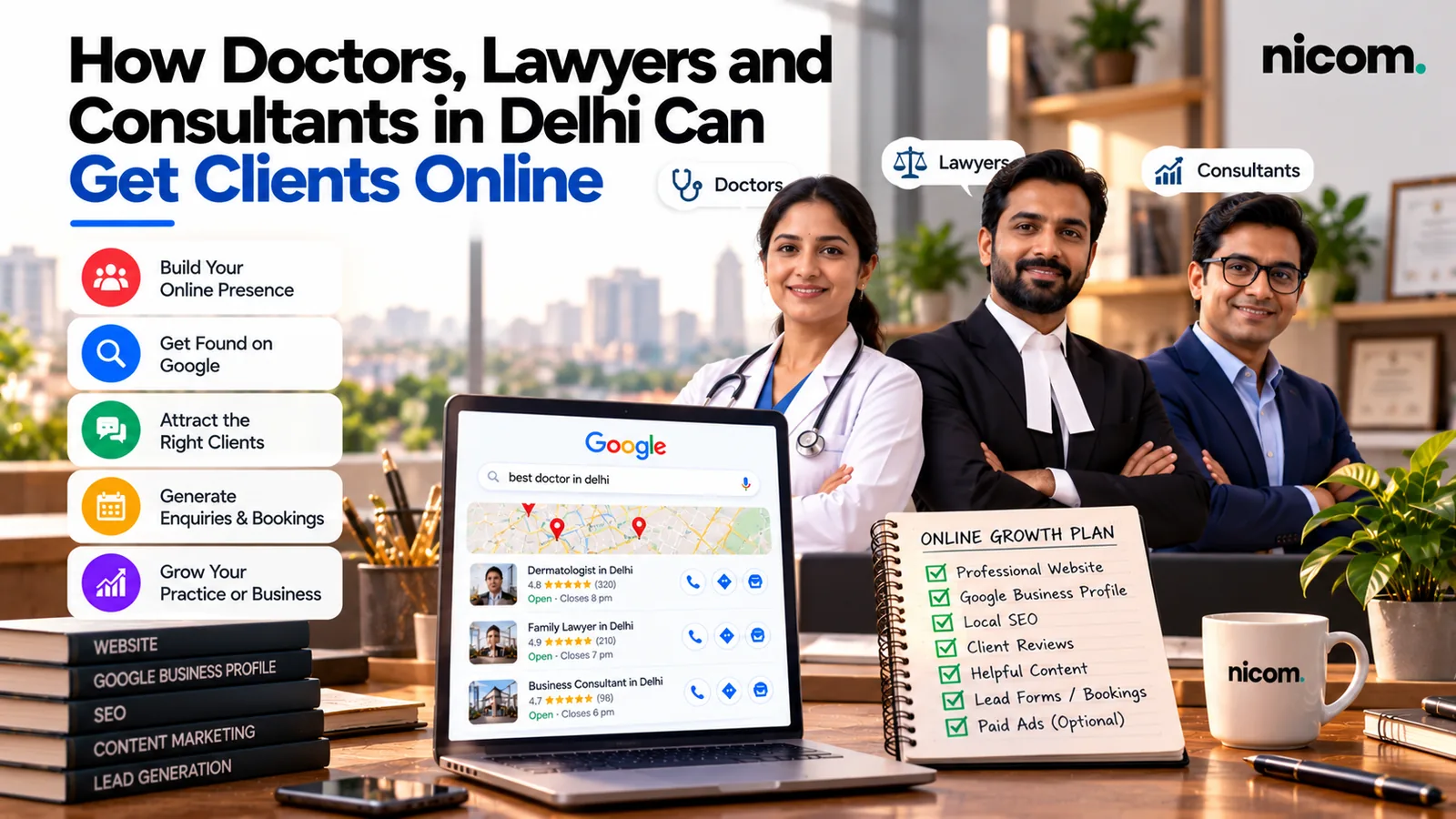
Short answer: for doctors, lawyers and consultants in Delhi, getting clients online is mostly about being findable and trustworthy when someone searches for you or your specialty. That means a clear professional website, a complete Google Business Profile, helpful educational content, and fast, organised follow-up when someone gets in touch. The big difference from other businesses is that doctors and lawyers work under professional conduct rules that limit advertising and self-promotion, so the right approach is information-led, not sales-led. Consultants have more freedom and can use LinkedIn, content and ads more actively.
This guide explains how to get clients online in a way that fits each profession, what to avoid, and where to start if you’re short on time. It is general marketing guidance, not legal or regulatory advice. Always check the current rules of your own council or professional body.
How clients choose a professional today
Most people still find doctors, lawyers and consultants through referrals. What has changed is what happens next. Before calling, people usually:
- Search your name or your practice’s name on Google.
- Look at your Google Business Profile, timings, location and reviews (where reviews are appropriate).
- Visit your website to check qualifications, areas of practice and how to reach you.
- Look you up on LinkedIn, especially for consultants and corporate-facing lawyers.
Others don’t have a referral and search directly: “dermatologist in Pitampura”, “property lawyer in Rohini”, “GST consultant near me”, “HR consultant for startups Delhi”. Being visible and credible in both situations is what brings enquiries.
First, understand the rules for your profession
Doctors
The Indian Medical Council (Professional Conduct, Etiquette and Ethics) Regulations, 2002, published on the National Medical Commission’s website, treat soliciting patients directly or indirectly as unethical. They also restrict publicity that invites attention to a doctor’s skill or achievements in a self-aggrandising way, and prohibit boasting of cases, cures or remedies. The NMC issued new professional conduct regulations in 2023, including social media guidance, but these were later put on hold. Check the current position with the NMC or your state medical council before planning any promotion.
In practice, most doctors keep their online presence factual and educational:
- Accurate information about qualifications, registration, specialties, clinic timings, location and fees.
- Educational content on common conditions, prevention and when to see a doctor.
- No patient testimonials, before-and-after images, outcome claims or “best doctor” language.
- No patient photographs, scans or case details shared publicly.
Lawyers
Rule 36 of the Bar Council of India Rules says an advocate shall not solicit work or advertise. A 2008 amendment allowed advocates to furnish specific website information prescribed by the BCI: name, contact details, enrolment details, bar association, professional and academic qualifications, and areas of practice. Anything beyond the approved particulars may be treated as a violation. That rules out most conventional marketing for advocates: ads, testimonials, “top lawyer” claims and client lists. Speak to your State Bar Council if you’re unsure what is permitted.
Consultants
Management, tax, HR, IT, business and other consultants who are not bound by a professional body’s advertising restrictions can market more freely. If you’re a chartered accountant, company secretary or member of another regulated body, check your institute’s code of ethics first, as many have their own rules on advertising and solicitation.
The foundation: a professional website
Whatever your profession, your website is the one place you fully control. It should be fast, mobile-friendly and easy to update, and it should answer what a prospective client wants to know:
- Who you are: name, qualifications, registrations and experience, stated factually.
- What you do: a clear page for each specialty, area of practice or service.
- Where and when: address, map, timings, consultation modes (in person, video, phone).
- How to get in touch: phone, WhatsApp, email and, where appropriate, an appointment request form.
- Helpful content: articles or videos that answer common questions.
For advocates, keep the website within the particulars the BCI allows. For doctors, avoid testimonials and outcome claims. Our website design and development team builds professional sites that stay within these limits.
Be easy to find on Google and Maps
Much of the search for professionals is local. A complete, accurate Google Business Profile helps people find your clinic, chamber or office, get directions and call. Use your real practice name, the most specific category, accurate hours and real photos of your premises. Google says local results are mainly based on relevance, distance and prominence. We cover the details in our guide to Google Business Profile for Delhi NCR businesses. Our local SEO service handles this end to end.
A note on reviews: Google allows reviews on business profiles, but the professional rules above matter more. Doctors in particular should not request or share patient testimonials. If reviews appear on your profile on their own, a short, professional reply that doesn’t discuss the patient’s condition or case is the safe approach.
Educational content that builds trust
Content is the most useful marketing tool for professionals, because it helps people while showing your expertise.
For doctors
- Articles and short videos explaining common conditions, tests and treatments in plain Hindi or English.
- Seasonal guidance relevant to Delhi, for example during high-pollution months or dengue season.
- “When should you see a specialist?” pieces that help patients decide.
For consultants
- Practical guides on the problems your clients face: compliance deadlines, hiring, process improvement, funding, technology choices.
- Explainers on regulatory changes that affect your clients.
- Short videos or reels answering one question at a time.
For lawyers
Many advocates write for legal journals, speak at seminars or teach. Given Rule 36, check with your Bar Council before publishing marketing-style content on your own website or social media.
Video works especially well for professionals because people want to see and hear the person before they book. Our video and reels team helps plan and produce short educational videos.
LinkedIn for consultants and B2B professionals
If your clients are businesses, LinkedIn is usually the most valuable platform:
- A clear headline that says who you help and how, not just your job title.
- An “About” section written around client problems.
- Regular posts sharing practical insights, frameworks and lessons from your field, without breaching client confidentiality.
- Genuine engagement with posts from the people you want to work with.
Consistency matters more than volume. One thoughtful post a week, kept up for months, does more than a burst of activity followed by silence.
Paid ads: when they make sense
For consultants, Google Search ads on specific service keywords and LinkedIn or Meta ads to a defined audience can bring enquiries quickly. Our comparison of Google Ads vs Meta Ads for lead generation in India explains how to choose.
For doctors and advocates, paid promotion is where professional rules are most likely to be an issue. Check with your council first. Ad platforms also have their own policies for healthcare and legal advertising.
Handle enquiries like a professional practice
Online visibility only helps if enquiries are handled well. Simple steps make a big difference:
- One number everywhere. The same phone number on your website, Google profile and directories.
- Quick acknowledgement. An automatic WhatsApp or email reply that confirms receipt and shares timings or next steps.
- A simple booking process. An appointment request form or calendar link for consultations.
- A record of every enquiry. A basic CRM or even a shared sheet, so nothing is forgotten and you can see which channels bring clients. Our guide to choosing a CRM for small businesses in India covers the options.
- Confidentiality. Keep client and patient information secure, and be careful what is discussed over public channels.
Where to start if you’re short on time
| Priority | Doctors | Lawyers | Consultants |
|---|---|---|---|
| 1 | Accurate Google Business Profile | Website with BCI-permitted particulars | Clear website with service pages |
| 2 | Factual website with specialties, timings and fees | Accurate Google Business Profile with contact details | Optimised LinkedIn profile and weekly posts |
| 3 | Educational articles or videos | Professional network and referrals | Educational content and Google Business Profile |
| 4 | Organised enquiry handling and appointment booking | Organised enquiry handling | Targeted ads and CRM follow-up |
Frequently asked questions
How can a consultant get clients online in Delhi?
Start with a clear website that explains who you help and how, an optimised LinkedIn profile with regular posts, a Google Business Profile if you have an office, and educational content that answers your clients’ questions. Add targeted ads once the basics are in place.
Can doctors in India advertise on social media?
Doctors should be very careful. Professional conduct regulations treat soliciting patients and self-aggrandising publicity as unethical. Factual information and educational content are the safer path. Check the current rules with the NMC or your state medical council.
Can lawyers in India have a website?
Yes. Under the 2008 amendment to Rule 36 of the Bar Council of India Rules, advocates can publish specific prescribed information on a website, such as name, contact details, enrolment details, qualifications and areas of practice. Content beyond those particulars may be treated as a violation.
Is a Google Business Profile useful for professionals?
Yes. It helps people find your clinic, chamber or office, see your timings and get directions. Keep the information accurate, and follow your profession’s rules when replying to reviews.
How long does it take to get clients from online channels?
A complete Google profile and a good website can start helping fairly quickly. Content, SEO and LinkedIn usually take several months of consistent effort before they bring a steady flow of enquiries.
Build a professional online presence
We help doctors, consultants and other professionals in Delhi NCR build websites, search visibility and content that fit their profession. Learn more about our work with personal brands and professionals and professional services firms, find more guides on our Insights page, or get in touch to talk about your practice.