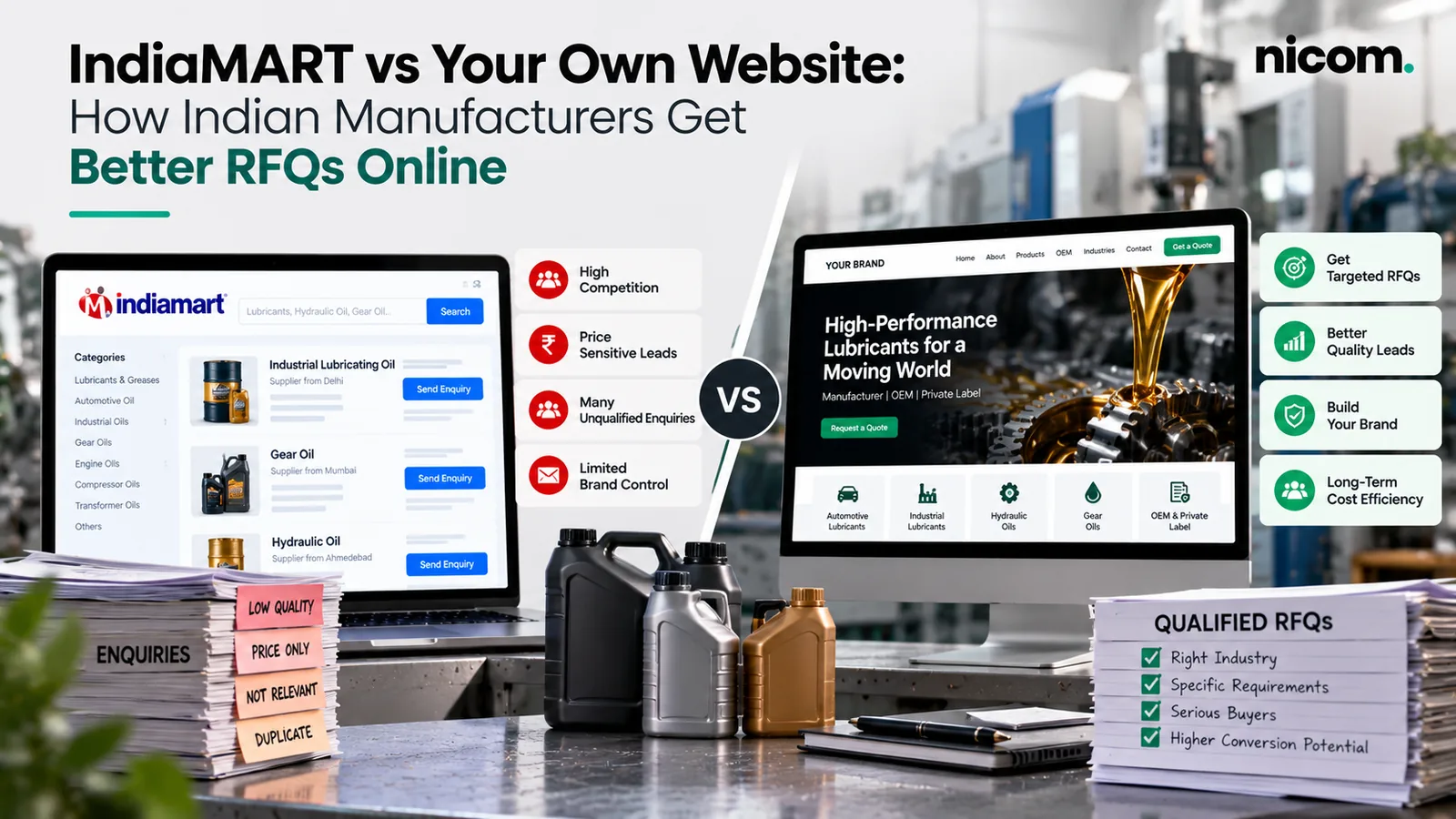
Short answer: IndiaMART and similar B2B portals are good for quick enquiry volume, but those leads are shared with other suppliers and often turn into a price war. Your own website, built around the exact products, specifications and applications buyers search for, brings fewer but more serious RFQs that come only to you. Most Indian manufacturers do best with both: keep the portal for reach, and build an owned channel (website, SEO, targeted Google Ads, LinkedIn and a proper follow-up system) that steadily reduces dependence on it.
Good lead generation for manufacturers is less about more traffic and more about the right buyers reaching you directly. This guide is for manufacturers, fabricators, machine builders, component suppliers and industrial distributors (we also work with B2B distribution businesses) who want better enquiries, not just more of them.
How industrial buyers actually look for suppliers
A purchase manager or plant engineer rarely searches for “best manufacturing company”. They search for exactly what they need: a machine type, a grade, a size, a process or an application, often with “manufacturer”, “supplier” or a city name. For example: “SS 304 sheet laser cutting Delhi”, “hydraulic press machine manufacturer India” or “industrial gear oil supplier NCR”.
Before sending an RFQ, they usually:
- Check whether you make exactly what they need (range, capacity, materials, tolerances).
- Look for proof: certifications, factory photos and videos, client industries, years in business.
- Compare several suppliers, often on portals and websites at the same time.
- Consult engineering, quality and finance colleagues before deciding.
Whoever makes that research easiest, and responds fastest and most professionally, gets shortlisted.
IndiaMART and B2B portals: what they’re good and bad at
According to IndiaMART’s own help centre, a BuyLead is a buyer’s purchase requirement that IndiaMART filters and shares with suppliers dealing in those products. Suppliers then choose which BuyLeads to consume to get the buyer’s contact details. That model has clear pros and cons.
| B2B portals | Your own website and SEO |
|---|---|
| Fast to start, immediate enquiry flow | Takes months to build rankings |
| Leads shared with multiple suppliers | Enquiries come only to you |
| Strong pressure to compete on price | You can compete on capability and trust |
| Mixed quality, including small retail buyers | Content filters for your ideal buyer |
| Ongoing subscription, results stop if you stop | Pages keep working after they’re built |
| Your profile looks similar to everyone else’s | You control how your capability is presented |
The practical takeaway: don’t abandon portals overnight. Use them for reach while your own channel grows, and track which source actually produces orders, not just enquiries.
Building an RFQ-generating website
1. One page per product, process or capability
A single “Products” page listing everything won’t rank for specific searches. Create a dedicated page for each main product line or process, with:
- A clear title using the terms buyers search for
- Specifications, sizes, capacities, grades and tolerances
- Applications and industries served
- Real photos and, ideally, short videos of the product or process
- Downloadable brochure or technical data sheet
- A clear RFQ call to action
2. Application and industry pages
Many buyers search by problem or application (“conveyor for packaging line”, “lubricant for high-temperature bearings”). Pages that explain which of your products fit which applications capture these searches and show expertise.
3. Proof of capability
Industrial buyers are cautious. Show certifications (ISO, BIS and others relevant to your sector), plant and machinery list, quality checks, and the industries you supply. Name clients only with their permission. Factory and process videos are especially persuasive and can be reused on LinkedIn, YouTube and WhatsApp.
4. An RFQ form that qualifies the enquiry
A form that only asks for name and phone creates work for your sales team. Ask for what you need to quote:
- Product or part required
- Material, grade or specification
- Quantity and frequency (one-time or monthly)
- Delivery location
- Timeline
- Drawing or specification upload (PDF, DWG, image)
- Company name and role
Put a WhatsApp button next to the form. Many Indian buyers prefer to send a drawing or photo on WhatsApp.
5. Technical basics
Fast loading on mobile, clean structure, proper page titles, and the site registered in Google Search Console. Our SEO and organic growth work for industrial clients usually starts with a product-and-keyword map: which page should rank for which search.
Adding paid channels the right way
Google Search Ads
Run campaigns on specific product and specification keywords, with “manufacturer” and “supplier” variations, and send traffic to the matching product page, not the homepage. Industrial keywords can be expensive per click, but volumes are small and intent is high. Judge them by cost per qualified RFQ. Our comparison of Google Ads vs Meta Ads for lead generation in India explains why search often suits B2B.
LinkedIn is useful for reaching procurement, plant and engineering roles at target companies, and for building credibility with regular posts about projects, capabilities and quality processes.
Retargeting
Industrial purchases take time. Retargeting people who visited your product pages keeps you visible during their internal approvals. See our guide to retargeting for small businesses in India.
Follow-up: where most manufacturers lose RFQs
A good enquiry is wasted if it sits in someone’s inbox for two days. What a basic system looks like:
- All enquiries in one place: website, portals, ads, WhatsApp and phone, captured in a CRM or at least a shared sheet.
- Instant acknowledgement by email or WhatsApp, with the name of the person who will handle it.
- Qualification within hours: does the quantity, specification and location fit?
- Quote with a follow-up date recorded.
- Regular follow-up over the buyer’s decision cycle, which can run for weeks or months.
- Outcome recorded: won, lost (with reason) or on hold.
Our guide to choosing a CRM for small businesses in India covers the options. For industrial clients, we usually connect portal leads, website RFQs and WhatsApp into one pipeline so the owner can see every open enquiry.
A realistic roadmap
| Phase | Focus |
|---|---|
| Month 1 | Audit current sources and lead quality. Fix tracking. Set up RFQ form, WhatsApp and a simple CRM pipeline. |
| Months 2–3 | Build or rewrite key product and application pages. Start focused Google Search campaigns. |
| Months 4–6 | Add proof content (videos, certifications, case examples). Begin LinkedIn activity and retargeting. Review portal ROI. |
| Ongoing | Expand pages for more products and applications. Compare cost per order by source and shift budget accordingly. |
This is general guidance. Timelines vary with your starting point and how competitive your products are.
Frequently asked questions
Should I stop using IndiaMART?
Not straight away. Keep it while your own website and SEO start producing enquiries, track which source brings actual orders, and decide on renewal based on that data.
Does SEO work for B2B manufacturers in India?
Yes, especially for specific product, specification and application searches. Search volumes are smaller than consumer markets, but each enquiry can be worth a lot.
What should a manufacturer’s website include?
Dedicated product or capability pages with specifications, applications, real photos or videos, certifications, downloadable data sheets, and an RFQ form that collects quantity, specification and drawings.
Is LinkedIn useful for industrial companies?
Yes, for reaching procurement and engineering decision-makers and building credibility. It works best alongside search and a strong website, not on its own.
How do I know which lead source is best?
Record the source of every enquiry and track it through to quote and order. Compare cost per order by source, not just the number of enquiries.
Want more serious RFQs?
We work with manufacturers and industrial suppliers on websites, search, ads and follow-up systems that bring direct enquiries. Read more about our work for the manufacturing and industrial sector and our lead generation services, or ask for a free RFQ-readiness review of your website. You can find more practical guides on our Insights page.